
CONSTANT WATTAGE HEATER CABLES
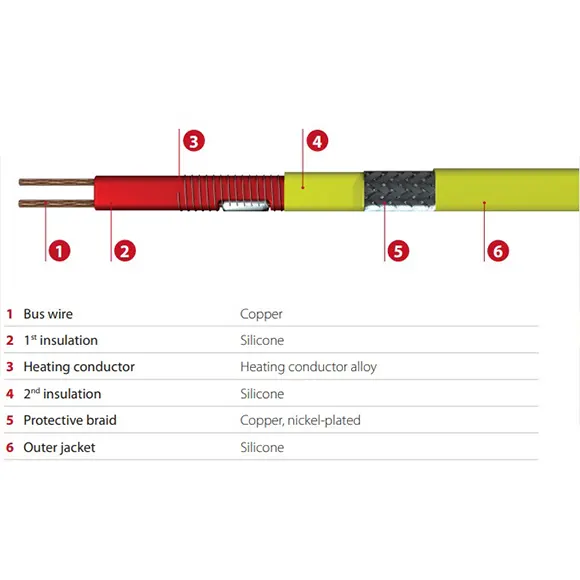
Type ELP-Si up to 200°C Constant Wattage Trace Heater With Resistance Wire
The installation of this heating cable is highly cost-efficient with any kind of heat tracing application thanks to the single end power input. The heating cable consists of a succession of heating zones (length = contact spacing) and can be cut to length in sections of the contact distance to the required length. When cutting into lengths, the heating circuit is interrupted up to the next contact point and this non-active part can be used as a cold lead. During the design phase, one contact spacing length per planned heating circuit must be calculated additionally.
Advantages:
- Single end connection
- Can be cut off the roll
- Constant power output per meter
- Highly flexible
Applications:
- Vessels, piping, valves
- Food processing industry
- Frost protection and temperature maintenance on pumps, etc.

Type ELP-PFA up to 260°C Constant Wattage Trace Heater With Resistance Wire
These parallel heating cables offer tremendous flexibility in use, as they can easily be cut to the required length off the roll, with the assurance of constant power output. There is no need for a connecting cable, and input can be unilateral. It is quick and easy to assemble; this saves a lot of time, and as a result reduces cost considerably. Since output of up to 60 W/m is possible for lengths laid to piping, ELP parallel heating cables are particularly suitable for piping with high output requirements, such as in industrial process technology. The particularly temperature-resistant outer shell in PFA and the high level of chemical resistance of the PFA ensure a long useful life.
Advantages:
- Single end power input
- Can be cut off the roll
- Constant power output per meter
- Long life cycle
- Laying without exact measuring possible
- High chemical resistance
Applications:
- Vessels, piping, valves
- Building construction
- Food processing industry
- Paper industry